You've got a logo you like, and now you're wondering whether someone could copy it. That's usually the moment people ask how to trademark a logo. The good news: in the US you can file the application yourself, online, without a lawyer, as long as you're based in the country.
The less good news is that the fee page alone won't tell you what you'll pay. The USPTO changed its fee structure in January 2025, and a vague description of your products now adds surcharges. So on November 8, 2026, I put the USPTO's published fees side by side and worked out five common filing scenarios. They range from $350 to $700 before you've hired anyone.
Here's what this guide covers:
- the six steps from "I have a logo" to "I have a registration"
- how to search for lookalike logos when the USPTO's search has no image upload
- what a logo trademark costs in fees, scenario by scenario
- the UK and EU fees, if you sell outside the US
One thing before we start: this is a practical walkthrough, not legal advice. If your brand has real money behind it, a trademark attorney is worth the fee.
How Can I Trademark a Logo?
You trademark a logo in the US by filing an application with the US Patent and Trademark Office (USPTO). You search for similar marks, upload a JPG of the logo as a "special form" drawing, list the goods or services it covers, and pay $350 per class. An examining attorney then reviews it.
You don't strictly need to register at all. According to the USPTO, "You become a trademark owner as soon as you start using your trademark with your goods or services." Those rights only reach the area where you actually do business, though. Registration is what gives you nationwide rights, and the right to use the ® symbol.
Before You Start
Have these ready before you open the application:
- A final version of the logo. You can't swap the design after you file, so don't register a draft. If you're still refining it, finish that first (this guide to drawing a logo covers the sketch-to-vector part).
- A JPG file of it. The USPTO wants a JPG of 5 MB or less. If all you have is a transparent PNG, export a copy on a white background.
- A settled business name. A logo built around a name you later change has to be filed again.
- A list of what you sell. You'll describe your goods or services in the application, and the wording affects the price.
- A USPTO account. Applications are filed in the USPTO's online Trademark Center.
Step 1: Make Sure Your Logo Can Be a Trademark
A logo can be a trademark if it identifies where your goods or services come from. The USPTO's definition is broad: "A trademark can be any word, phrase, symbol, design, or a combination of these things that identifies your goods or services" (USPTO).
In practice, that rules out a few things:
- Generic images. A plain drawing of a coffee cup for a coffee shop tells customers what you sell, not who you are.
- Decoration. A pattern that only makes a product look nice may not read as a brand.
- Lookalikes. A design close to an existing mark for related products is the problem Step 2 is about.
Distinctive marks do best. The cool logos roundup has examples of brands that used one clever idea to make their mark hard to confuse with anyone else's.
You also need to be using the logo, or to have a real plan to. That choice becomes your "filing basis" in Step 5.
Step 2: Search for Similar Logos
Search the USPTO's database before you pay anything, because a similar existing mark is the most likely reason you'll be turned down. The USPTO says likelihood of confusion is "the most common reason for refusing registration" (USPTO). It means consumers would think your goods and someone else's "come from the same source."
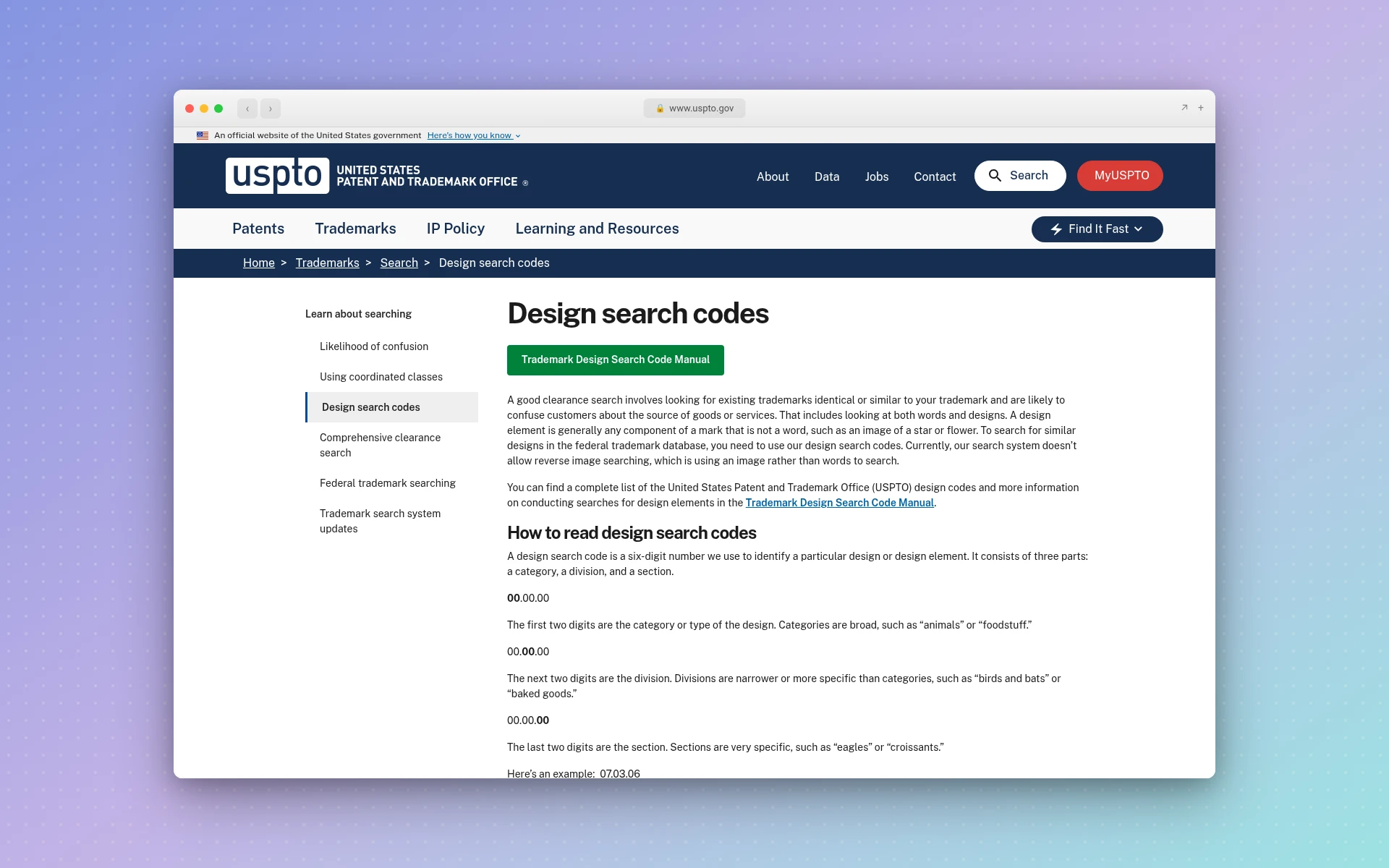
The catch with logos: you can't upload your image and get matches back. The USPTO says plainly that "our search system doesn't allow reverse image searching" (USPTO). You search with words and codes instead.
Here's how to search for a logo:
- Search the words in your logo first. Open the Trademark Search system and look up your name and any words in the design.
- List your logo's main design elements. A star, a shield, a leaf, a stylized letter.
- Find the design search code for each. A design search code is "a six-digit number we use to identify a particular design or design element," per the USPTO. For example, 02.01 covers human beings.
- Search by those codes. Narrow the results to the classes that match what you sell.
- Read the results the way an examiner would. Similar sound, look or overall impression counts, even when two marks aren't identical.
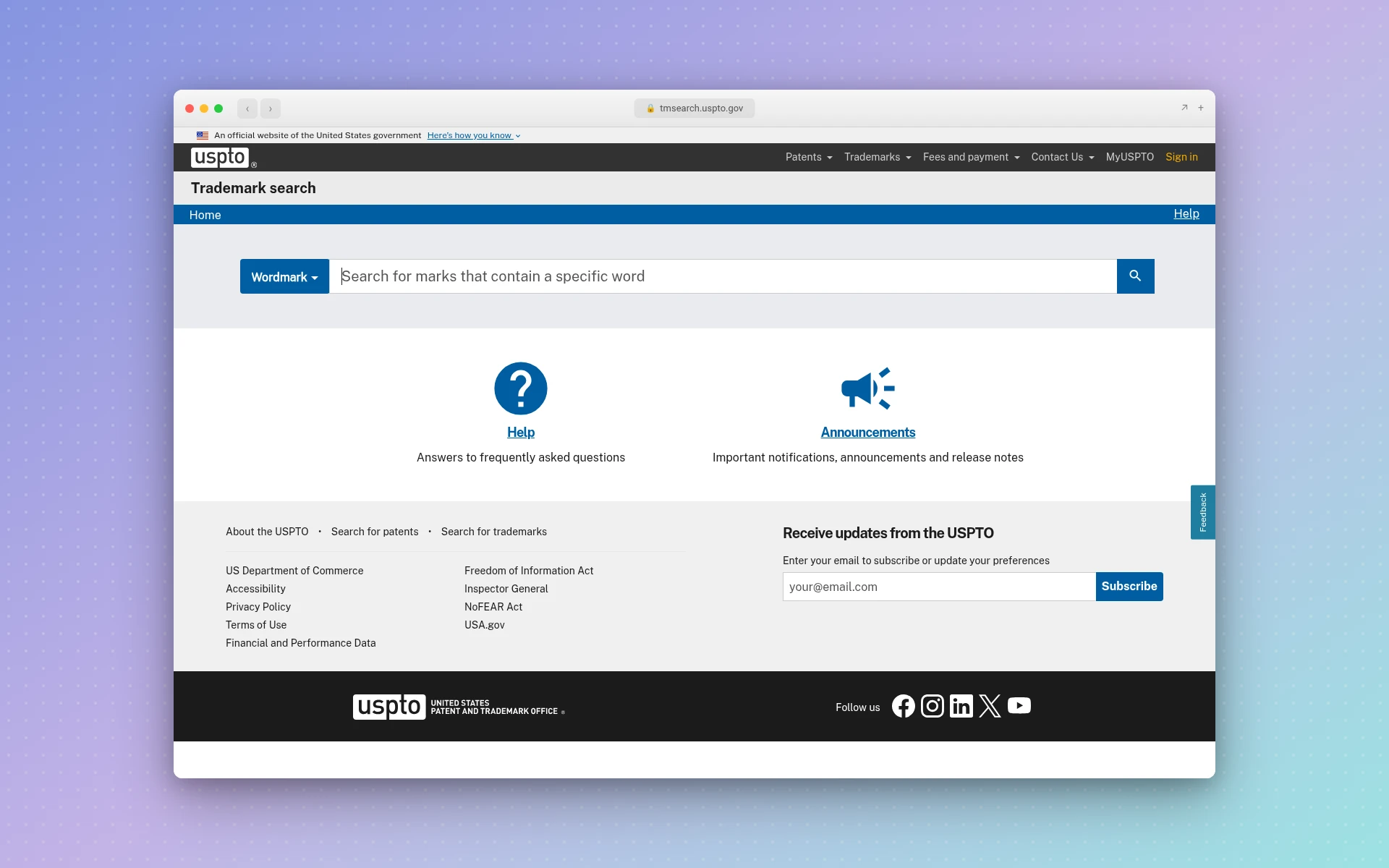
Logged-in users get a smoother ride: the USPTO's search page says signing in "helps you avoid errors when the system is handling heavy traffic."
Step 3: Decide Whether to File the Logo, the Name or Both
Most small businesses get more protection from registering their name than their logo. That surprises people, so here's why.
The USPTO offers two kinds of drawing, and "you cannot choose both" in one application (USPTO):
| Drawing type | What it protects | Best for |
|---|---|---|
| Standard character | The words, in any font, style, size or color. The USPTO calls this "the broadest form of protection" | Your business name |
| Special form | Only "the particular depiction you provided" | Your logo's design |
A special form registration covers the logo as you drew it. Redesign it in five years and the new version may need its own application. A standard character registration of your name covers it in every logo you ever make, which is why it's usually the first filing. (If your logo is your name set in type, the wordmark logos guide shows how those are built.)
Larger brands do both. The USPTO notes that companies may register "a business name, a slogan, and a logo to ensure the broadest possible protection." Each one is a separate application with its own fee. A logo with a strong symbol is the best case for a separate logo filing, and this explainer on what a logo mark is covers why symbols often get registered on their own.
Step 4: Pick Your Classes and Describe Your Goods
Every application lists the goods or services the logo covers, grouped into classes, and you pay per class. A bakery that sells bread and also runs a café would likely need two classes, one for the goods and one for the service.
This is where the 2025 fee changes bite. According to Fish & Richardson's summary of the new fees, effective January 18, 2025:
- writing your own description in the free-form text box, instead of picking entries from the USPTO's ID Manual, costs $200 more per class
- each additional 1,000 characters of description beyond the first 1,000 costs another $200 per class
- an application missing required information costs $100 more per class
So pick the closest pre-written descriptions from the ID Manual wherever you can. Only file in the classes you actually sell in today or have a firm plan for.
Step 5: File Your Application With the USPTO
You file in the USPTO's online Trademark Center. The USPTO's fee page says: "The base application fee for each class of goods or services you include in your application is $350."
For a logo, the application asks for:
- The owner. The person or company that will own the mark.
- A special form drawing. Your JPG, 5 MB or smaller, with a file name under 256 characters and no zipped files (USPTO).
- Color, or not. Show the logo "in black on a white background" unless color is part of the mark. To claim color, you upload a color drawing, state that color is a feature, and describe where each color appears. A black-and-white filing isn't tied to one color scheme.
- A description of the mark and any words in it.
- Your goods and services, from Step 4.
- A filing basis. "Use in commerce" if you're already selling under the logo (you'll upload a specimen showing it in use, like a product label or a web page). "Intent to use" if you're not selling yet.
Based outside the US? Then "you must have an attorney who is licensed to practice law in the United States," per the USPTO's process page. US-based applicants can file alone, though the USPTO encourages using one.
Step 6: Follow the Application to Registration
After you file, an examining attorney reviews the application and runs their own search. The USPTO says this "may take a number of months" (USPTO). Here's what follows, with the deadlines from that page:
- Office action (if any). If the examiner objects, you have three months to respond, with an optional three-month extension for a fee.
- Publication. Once approved, the mark is published, and anyone who thinks it hurts them has 30 days to oppose it.
- Registration or allowance. A use-based application moves to registration. An intent-to-use application gets a notice of allowance about eight weeks after publication.
- Statement of use (intent-to-use only). You have six months from the notice of allowance to show the logo in use, or to ask for more time.
- The certificate. It issues within about two months after the statement of use is approved.
Then the clock starts on upkeep. The USPTO's maintenance page says the first filing is due "between the fifth and sixth years after the registration date," and the renewal "between the ninth and 10th years," then every 10 years after that. Miss them and you can lose the registration.
How Much Does It Cost to Trademark a Logo?
Trademarking a logo with the USPTO costs $350 per class in official fees for a clean application. It can rise to $550 or more per class if you write your own description of your goods, and intent-to-use filings add $150 per class later. Attorney fees, if you use one, come on top.
Here are the five scenarios I worked out on November 8, 2026, from the USPTO's fee page and Fish & Richardson's breakdown of the 2025 fees. All are electronic filings with no attorney:
| Scenario | How it adds up | USPTO fees |
|---|---|---|
| Logo, 1 class, ID Manual wording, already in use | $350 base | $350 |
| Logo, 1 class, not selling yet (intent to use) | $350 base + $150 statement of use | $500 |
| Logo, 1 class, your own free-form description | $350 base + $200 surcharge | $550 |
| Logo, 2 classes, ID Manual wording | $350 × 2 | $700 |
| Logo and name as separate filings, 1 class each | $350 + $350 | $700 |
And later on, per class: $325 for the declaration of use due in years 5 to 6 (per Fish & Richardson), and $650 at the 10-year mark, which the USPTO breaks down as "$325 for the declaration of use plus $325 for the renewal."
The cheapest realistic path is the first row: one class, pre-written descriptions, and a logo you're already using. If you're still budgeting for the logo itself, this breakdown of how much a logo costs covers the design side.
How to Find Out If a Logo Is Trademarked
To find out if a logo is trademarked in the US, search the USPTO's Trademark Search system by the words in the logo and by its design search codes, filtered to related classes. There's no image upload, so a logo with no words can only be found through codes and design descriptions.
A few things the database won't tell you:
- Unregistered marks. A local business using a logo has rights in its area without ever filing, so also search the web, app stores and your state's business records.
- Pending applications in other countries. A US search only covers US filings.
- What counts as "too similar." That's a judgment call, and the one most worth paying an attorney for.
Famous logos are almost always registered. The logo examples from famous brands roundup notes, for instance, that BMW's roundel is a registered trademark, so borrowing its look is a bad bet.
Trademarking a Logo Outside the US
A US registration only protects you in the US. If you sell elsewhere, you file with that country's office (or use an international route, which an attorney can walk you through). The two most common for English-speaking small businesses:
| Office | Official fee | Source |
|---|---|---|
| UK Intellectual Property Office | "at least £205" | GOV.UK |
| EUIPO (all EU countries) | €850 for one class online, €50 for the second, €150 for each class after that | EU Trade Mark Regulation, Annex I |
The UK is quick when nothing goes wrong. GOV.UK says it "usually takes around 3 to 4 months from application for your trade mark to be granted."
Common Mistakes
- Registering a logo you're about to change. The special form registration covers that exact design. Lock the design first.
- Filing the logo but not the name. If you can only afford one filing, the name usually protects more.
- Writing your own goods description by default. It's $200 extra per class when an ID Manual entry would do.
- Filing in classes you don't use. You pay for each one, and for a use-based filing you have to show use in each.
- Using ® too early. The USPTO says to use ® only once the mark is registered, and only for the goods or services listed. Before that, use ™ (or SM for services).
- Skipping the design-code search. A word search alone misses lookalike symbols.
Pro Tips
- Start with the name if money is tight, then file the logo once the design has settled and you're selling under it.
- File in black and white unless the color itself is the point of your brand.
- Keep a dated record of first use: the first invoice, product photo or web page with the logo on it. It helps if anyone ever questions who used it first.
- Put the renewal dates in your calendar the day the certificate arrives.
- Keep the logo simple. A clean mark is easier to describe, easier to search and easier to defend. The minimalist logos guide shows what that looks like.
Frequently Asked Questions
Can I trademark a logo myself?
Yes, if you're based in the US. The USPTO doesn't require US-domiciled applicants to use an attorney, though it encourages it. If you're based outside the US, you must use an attorney licensed in the US. Filing alone works best for a simple case: one class, ID Manual descriptions and no close lookalikes in your search.
How long does it take to trademark a logo?
In the US, expect months rather than weeks. The USPTO says the first review alone "may take a number of months," and publication adds a 30-day opposition window. Intent-to-use filings take longer, since you have up to six months after the notice of allowance to show the logo in use. In the UK, a clean application usually takes 3 to 4 months.
Should I trademark my logo or my business name first?
Usually the name. A standard character registration protects the words in any font or design, so it keeps covering you when you redesign. A logo registration covers only the design you filed. If the symbol in your logo is a big part of your brand, file both, as two separate applications.
Do I need a trademark to use my logo?
No. The USPTO says "You're not required to register your trademark," and you gain rights as soon as you use the logo in business. Those rights are limited to the area where you trade. Registration adds nationwide rights, the ® symbol and a public record that shows up when others search.
Can I trademark an AI-generated logo?
Trademark rights come from using a logo to identify your goods or services, so how it was made isn't the test: distinctiveness and lookalikes are. Copyright is a separate question. The US Copyright Office said in January 2025 that AI outputs "can be protected by copyright only where a human author has determined sufficient expressive elements" (Copyright Office). Run the same Step 2 search on an AI-made logo as on any other.
What's the difference between ™ and ®?
™ (or SM for services) tells people you claim a mark as yours, and you can use it without filing anything. ® means the mark is federally registered, and the USPTO says to use it only after registration and only for the goods or services in it. So hold off on ® until the certificate arrives.
Where to Go From Here
The short version: settle the logo and the name, search by words and design codes, file the name first if you can only afford one, use ID Manual descriptions, and diary the renewals.
If you don't have a final logo yet, sort that out before you file. LogoGen is one option: you describe your business, pick a style and colors, and it generates logo options, typically in under 10 seconds. It doesn't check trademarks, so run your favorite through Step 2 before you commit. You can also browse the logo types to see which style suits your brand, or try the business name generator if the name is still open.