Search for neon colors and you'll get a wall of glowing palettes, each with its own hex codes. Copy a "neon pink" from one site and a "neon pink" from another, and there's a fair chance you've got two different colors.
So I did two things on November 11, 2026. First, I compared the hex codes that five pages give for the same neon names. They all agree on neon green. For pink, yellow and blue, at least one page breaks ranks. Then I ran nine common neon codes through the WCAG contrast formula against white and black.
8 of the 9 reach the 4.5:1 ratio that normal text needs on black. Only 2 reach it on white.
What Are Neon Colors?
Neon colors are extremely bright, highly saturated versions of ordinary hues like green, pink, yellow, orange and blue. They look as if they glow. On a screen they sit at the edge of what a display can show, and in print the real thing is a fluorescent ink that turns invisible light into visible color.
There's no official list. "Neon" is a description, not a standard, which is why the codes vary from site to site. What they share is the look of a highlighter on a white page, or a bar sign seen from across the street at night.
Where Does the Name Neon Come From?
The name comes from neon signs, though pure neon gas only gives one color. The French physicist Georges Claude showed two 12-metre neon tubes at the Paris Motor Show in December 1910, and Wikipedia's history of neon lighting describes them as "bright red." The same page calls the light neon gives off on its own "orange," so think red-orange.
The other colors in a "neon" sign come from other gases and coatings. The same article notes that mercury gives blue and helium gives yellow or pink, while phosphor coatings glow when ultraviolet light from the gas hits them.
So "neon blue" isn't neon at all, chemically speaking. The word just stuck to anything that shines like a sign at night.
Are Neon and Fluorescent Colors the Same?
In everyday use, yes. Neon and fluorescent are used as names for the same super-bright colors, and Colors Explained notes that the two terms "are interchangeably used." As light sources they differ, but nobody shopping for a highlighter means anything else.
The fluorescent part is real chemistry, though. In the 1930s, brothers Bob and Joe Switzer of Berkeley started experimenting with fluorescent compounds. Berkeley's chemistry department says their paint could "absorb the UV black light and reemit it as a glowing pigment" (UC Berkeley Chemistry).
They went on to found DayGlo in 1946. Its daylight fluorescent pigments convert ultraviolet light to visible light, which is why they look brighter than ordinary paint (Wikipedia). The American Chemical Society later named them a National Historic Chemical Landmark.
9 Neon Color Hex Codes
The most common neon hex codes are neon green #39FF14, neon yellow #FFF01F, neon pink #FF44CC, neon blue #1F51FF and neon purple #BC13FE. These are the values Color Meanings lists, and Art in Context gives the same codes for green, pink, yellow and blue.
Here are nine neon codes, with my contrast check for each one against pure white and pure black. I worked out each ratio with the W3C formula. Anything at 4.5:1 or above is fine for normal text; 3:1 is the floor for large text.
| Color | Hex | Contrast on white | Contrast on black |
|---|---|---|---|
| Neon yellow | #FFF01F |
1.18:1 | 17.74:1 |
| Neon green | #39FF14 |
1.36:1 | 15.49:1 |
| Electric cyan | #0FF0FC |
1.41:1 | 14.89:1 |
| Neon pink | #FF44CC |
3.02:1 | 6.95:1 |
| Electric orange | #FF5E00 |
3.06:1 | 6.85:1 |
| Neon magenta | #EA00FF |
3.53:1 | 5.94:1 |
| Neon red | #FF3131 |
3.66:1 | 5.74:1 |
| Neon purple | #BC13FE |
4.50:1 | 4.66:1 |
| Neon blue | #1F51FF |
5.71:1 | 3.68:1 |
The names and codes come from Color Meanings. The table runs from brightest to darkest, and you can watch the two columns trade places as you go down.
Why Do Sites Disagree on Neon Hex Codes?
Sites disagree because there's no standard to copy from. Each one picks its own value for a name like neon pink. Neon green is the exception: all five pages I checked that name it use #39FF14, including Wikipedia's neon green entry and Kive.
Here's how the rest compared across the three pages that list most of them:
- Neon pink: two give
#FF44CC, and Colors Explained gives#FF1493. That second one is CSS's owndeeppink, per MDN. - Neon yellow: two give
#FFF01F, and one gives the greener#E6ED07. - Neon blue: two give a deep
#1F51FF, and one gives#00FFE5, which is closer to aqua. - Neon orange: only one page uses that name, for
#FF3503. The other two call their orange "electric orange," at#FF5E00.
My advice: don't trust the name. Pick the code you like on screen, write it down, and use that code everywhere.
Why Neon Colors Look Best on Black
Neon colors look best on black because most of them are very light, and light colors need a dark background for contrast. In my table, neon yellow and neon green score over 15:1 on black but under 1.4:1 on white, which is close to invisible.
That's why neon shows up on night-club posters, gaming screens and dark-mode interfaces. The dark background does half the work.
The middle of the table is more forgiving. Pink, orange, magenta and red all clear 4.5:1 on black and land around 3:1 to 3.7:1 on white, so they can handle a big headline on a light page but not a paragraph.
Neon blue is the odd one out. It's the only code here that's better on white (5.71:1) than on black (3.68:1). Neon purple sits right on the line on both, at 4.50:1 on white and 4.66:1 on black, so I'd keep it for large text to be safe.
One caveat: logos are exempt from WCAG's contrast rule, which lists text in a logo as an exception. A neon green logo on white isn't banned. It just won't be easy to see, and any text near it will need a different color.
Can You Print Neon Colors?
Not with standard four-color printing. Fluorescent colors can't be mixed from cyan, magenta, yellow and black. Printer 4OVER4 calls neon Pantone colors "impossible to simulate in process", because "process printing cannot reproduce shine or glow." You need a dedicated spot ink.
Pantone sells these as their own ink library. PANTONE 802 C, a green, sits in its "Pastels & Neons Coated" collection, and the page warns that on-screen colors are "computer simulations" that may not match the printed ink.
Screens have the opposite problem. A monitor can show #39FF14 at full blast, but it can't fluoresce. So the neon you approve on your laptop and the neon on your printed sticker will never be identical. Ask your printer for a proof before a big run.
When Do Neon Colors Work in a Brand?
Neon works in a brand when you want energy or to be seen, and when you can give it a dark backdrop. Think of a gaming channel's overlay or a cocktail bar's sign. A law firm or a dentist will usually want something calmer.
Visibility is the oldest use. DayGlo's pigments ended up on traffic cones and safety vests because people notice them (Wikipedia). Packaging caught on too: the same article says Tide became known for its fluorescent packaging from 1959.
If you're thinking about neon for your logo, a few rules hold up:
- Use one neon, not five. One loud color reads as a choice. Several read as noise. Decide how many colors your brand needs before adding a second.
- Pair it with a dark neutral. Black or a deep navy gives neon its glow, as the table shows.
- Keep a non-neon version. Your logo will end up on invoices, where fluorescent ink isn't an option. A version in solid black, like the one you'd start with when drawing a logo, is a must.
- Make a version with no background. Neon logos often sit on dark photos and screens, so you'll want the file this transparent logo guide walks through.
- Lean into a style on purpose. Neon goes well with the 80s-inspired looks in the retro logos guide, and it's striking in the clean shapes of minimalist logos.
For how brands with very bright leads still keep text readable, see these brand color palette examples. GitHub's color page, for instance, describes its digital look as "mostly neutral colors with small moments of green."
What Colors Go With Neon?
Black, charcoal, deep navy and dark purple go best with neon, because they make it glow. White and light grey work for neon blue and purple. For pairs of neons, try opposites on the color wheel, like neon pink with neon green, or neon blue with electric orange, and keep one of them small.
A few combinations that tend to work:
- Neon pink and electric cyan on black. The classic synthwave look.
- Neon green on charcoal. Sharp and techy, and easier on the eyes than pure black.
- Neon yellow with deep navy. Plenty of contrast, a little less aggressive than yellow on black.
- Neon blue on white. The strongest neon in my table for text on a light page.
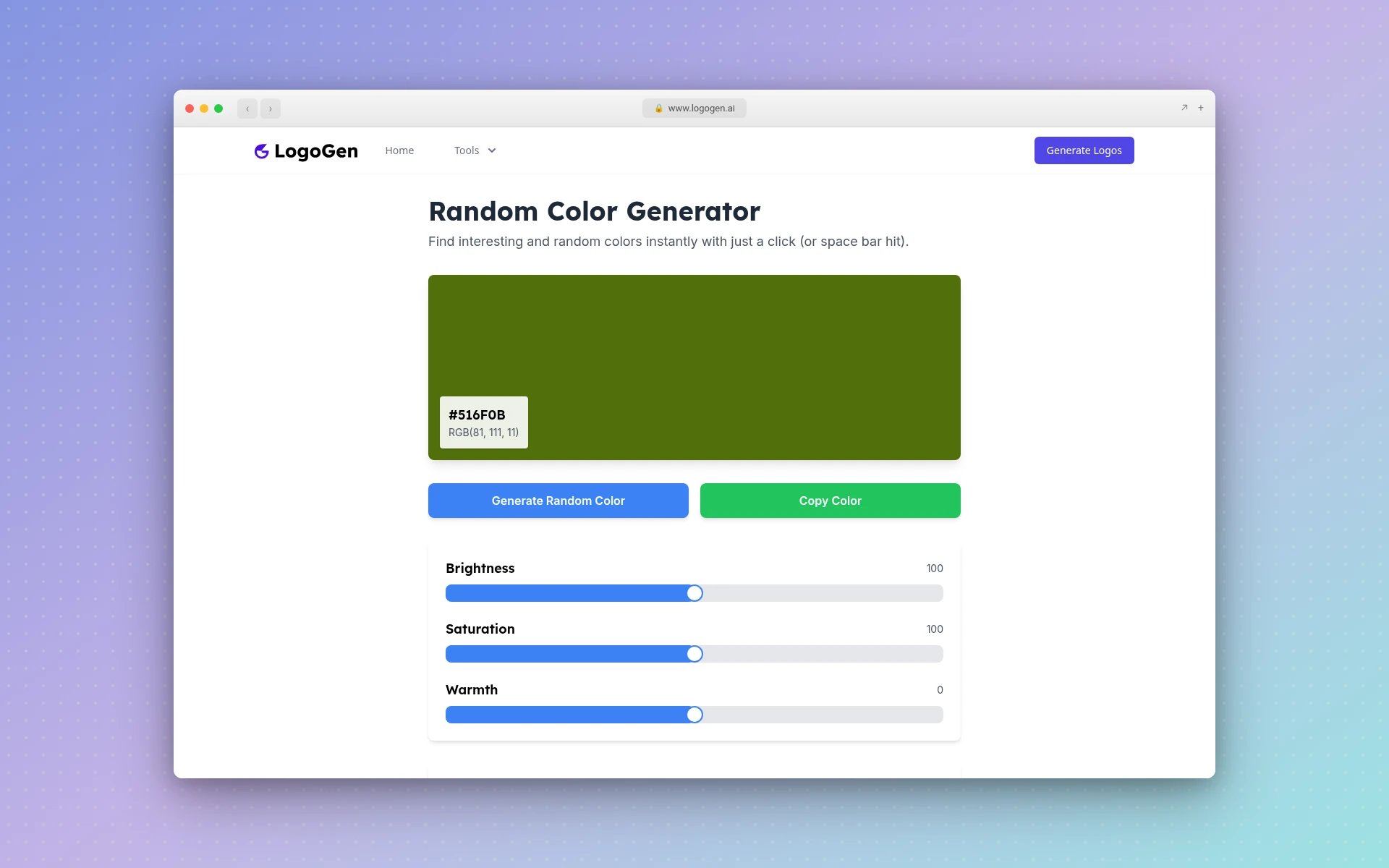
If you want a starting set to tweak, the free color palette generator gives you a random palette from any keyword you type in, and each one gets a shareable page. The random color generator is good for stumbling onto a bright shade you wouldn't have picked yourself.
Frequently Asked Questions
Is neon a real color?
Neon isn't a single color. It's a family of very bright, saturated shades, from green and yellow to pink and blue. The gas called neon does have its own glow, an orange-red, but "neon green" or "neon blue" just means a color bright enough to look lit up.
What is the brightest neon color?
Neon yellow is the brightest of the nine codes in my table. #FFF01F has the highest luminance of the set, which is why it hits 17.74:1 on black and only 1.18:1 on white. Neon green #39FF14 is a close second.
What are the hex codes for neon colors?
Common neon hex codes are neon green #39FF14, neon yellow #FFF01F, neon pink #FF44CC, neon blue #1F51FF, neon purple #BC13FE and electric orange #FF5E00. Sites don't always agree, so check the shade on screen before you commit. Neon green is the only one every page I checked shares.
Can I use neon colors for a logo?
Yes, as long as you plan for where it'll appear. Use one neon with a dark neutral, keep a solid black or white version for print, and expect to pay for spot ink if you want true fluorescent printing. Neon suits energetic brands better than formal ones.
How do I make a color look neon on screen?
Push it to full saturation and high brightness, then put it on a dark background. Most neon codes max out one or two of the red, green and blue channels. A soft glow effect around text or shapes helps sell the look, but the dark backdrop matters most.
Where to Go From Here
Neon colors are bright, saturated shades with no official codes, so pick yours by eye and write the hex down. Then give it a dark background, because 8 of the 9 codes I checked are readable on black and only 2 are on white.
If you want to see how a bright color looks on an actual logo, LogoGen is one option: you describe your business, pick a style and colors, and it generates logo options, typically in under 10 seconds. You can also browse the logo types or these logo examples from famous brands for ideas.